Showing posts with label Book Matters. Show all posts

Thursday, 17 September 2015

Book Review: The Thinking Indian (Guest Post: Gilu Mishra)

ॐ श्री गणेशाय नमः 
A perfect day to share the first detailed review of my e-book, The Thinking Indian


I am happy to host today, Gilu Mishra, a friend and a fellow lover and student of Sri Aurobindo and the Mother. Gilu and I first met several years ago in Pondicherry when she joined the institution where I was working at the time, to participate in some structured courses meant to help learners go deeper into some aspects of the wide-ranging thought and works of Sri Aurobindo. I had the privilege of serving as her facilitator for some of this study and research experience. Through this shared exploration and study experience, particularly of the major works related to the social, educational and cultural thought of Sri Aurobindo, we became better acquainted with each other and a friendship began to blossom.

Gilu has advanced degrees in nursing and psychology. Having worked for many years as a healthcare professional at a premier medical facility for many years, she presently works in the area of education of young children, especially at the pre-primary and primary levels. Originally from Kerala, Gilu now lives in New Delhi. As a seeker and life-long learner she writes about some of her reflections and life lessons, though not as frequently as she would like (I am sure!) at "all life is yoga.

What makes me doubly pleased about her presence on this space today is that her post is actually about me! (Pardon the Ego Moment!) Well, it is not really about me, but about an e-book that I wrote and self-published a few months ago. Gilu is here to present her review of "The Thinking Indian: Essays on Indian Socio-Cultural Matters in the Light of Sri Aurobindo."

Thank you Gilu, and a warm welcome!

******


http://www.amazon.com/Thinking-Indian-Socio-Cultural-Matters-Aurobindo-ebook/dp/B00WNBY6F4/
Click here to purchase


I present here some of my views regarding Dr. Beloo Mehra’s e-book ‘The Thinking Indian’, a collection of essays on several Indian Socio-cultural matters, as seen in the light of Sri Aurobindo.

Recently, during a casual conversation with a friend, our topic turned to the method of education being provided in the schools these days. We were talking about how today’s children are not interested in reading and how their thoughts are limited. ‘Thinking out of the box’ is out of question, we opined, but let them at least think! As I was reading through the e-book ‘The Thinking Indian.’ I remembered this conversation and about the ‘thought phobia’ (as Beloo quotes Sri Aurobindo) which has become fairly common now.

In the prelude, Beloo mentions that it is heartening to see people are becoming more open-minded and curious learners. This e-book is an excellent aid for such people, especially the young generation to contemplate about the current events and widen their spectrum of thought. The topics and instances provided in these essays may act as a spark to the light the fire within. All the essays are written in an ‘easy to read’ manner which will definitely appeal to every reader and not only those with an academic frame of mind. There is definitely at least one topic to which every individual can connect.

This e-book consists of nine essays related to Indian socio-cultural matters. Beloo presents a myriad of topics ranging from Spirituality, Hinduism to commercialism and movies! And all topics are contemporary, making them interesting to even the ‘not concerned about what is happening in the world’ younger generation. There is one essay inspired by the movie ‘The Monuments Men’ and there are two essays based on the TV serials ‘Ramayana’ and ‘Mahabharata.’ There is one essay about spirituality being the master-key of Indian mind and another one about Indian culture.

For the one who is more materialistically oriented there are essays on commercialism and the study of Indo-American people where she talks about the evolution of the group soul. I am sure all these essays give a different point of view regarding the matter and would definitely encourage the reader to explore more regarding the same. For example, in her essay ‘Don’t Blame the Culture’ she talks about two sides of a behaviour may be seen simultaneously. One may see some people jumping the queue in a public place and at the same time there may be some people who will let a more deserving person move ahead of them! Presenting such examples, she forces us to think about the individual behaviour rather than the common trend of blaming the culture.

In most of her essays, Beloo gives us some questions to ponder on. In her first essay, ‘Spirituality, the Master-key of the Indian Mind’ she asks, “What does it mean to grapple with the infinite and how is it native to Indian mind?” Another interesting question is given to us in the second essay ‘Don’t Blame the Culture’ when she asks, “Shouldn’t we be concerned about learning what a culture really is before we start finding faults with it?” Or when she asks, “Can a piece of art be more worth than a human life?” in the essay ‘On Movies, Art and Culture.’ I am sure each of the readers would really stop for a while to think about these questions.

Many of her essays are lined with her personal experiences or observations as well, which are again some things that the reader will be able to connect with. One example where I did sit up and thought “This happened to me too...” was the picture of the sunset on page 22. Just as Beloo did, I too said, “Wow, what a beauty!” And as I continued to read her explanation of ‘The God’s Labour,’ I was mesmerized! I would not be doing justice if I talk about it here, it would be better if one reads the author herself! This is just one example. There are several such instances in this e-book which I am sure the readers will be able to identify with. In many of these instances, the reader may see that Beloo has given words to bring out his/ her own sentiment.

There is one essay about the Hindi novel ‘Abhyuday’ titled ‘Re-telling Classical Literature, Awakening a Generation: Case of Ramayana.’ In this essay, she talks about how the author presents Ramayana in the modern setting and the relevance of Ram in the present intellectual society. Here also she provides certain instances to explain this point. How Ram faces the dilemma of war, how he learns about the cruelty and oppression faced by the people and even the story of Ahalya is told in a new perspective. Beloo has to be given credit that I, one who is not very fond of Hindi literature, is tempted to read the novel after reading what she has written about it!

As Beloo says in the title of the e-book, her essays are in the light of Sri Aurobindo. Sri Aurobindo’s words are significant even now and inspire everyone who turns to Him. To quote her, “It will be well worth reminding ourselves of these words of Sri Aurobindo that are meant to guide us through these wrong steps and detours, and inspire us to search for the soul of India that is leading her to her unique mission in the world.”

I could go on about how this little e-book ‘The thinking Indian’ is a motivation for every individual, but it would definitely be better for each to read on his/her own and be invigorated.

To conclude, I wish that the vibration of positive and open thinking which Beloo inspires is well received and more and more people are motivated by her.

Friday, 5 June 2015

Buy Less, Be an Environmentalist

A new post in the series - Reminders to self

June 5, World Environment Day

Some people plant trees in their neighbourhoods. Some people go on nature walks. Some people clean up the local rivers and lakes. Some people start a campaign to make their cities greener. All noble efforts, all important initiatives.

World Environment Day is also a day when....

...we must question our consumption habits,
...we must reflect upon our purchasing patterns,
...we must ponder upon the impact of our consumerist lifestyle on the environment.

Source


Let us be honest. Do we worry about how our consumption patterns and spending habits impact the environment? What happens to all the stuff we discard when we buy new stuff? What happens to all the plastic packaging that we end up adding to the garbage dumps every time we purchase a new product? From where are all the natural and energy resources coming to manufacture all the goods we keep on purchasing? What about the fuel costs to ship the products all the way from China, Philippines, Malaysia or wherever else these products are being manufactured? What about.....what about....so many questions to ponder upon when we start on this path of reflection.

But the key question remains -- Why do we keep buying? Do we really need all the things we buy? Or are we just buying to satisfy some desires, some wants in the hope that acquiring more things will bring us happiness? Do we know how to carefully discern between what is really a need and what is a desire when we enter a store or step into a shopping mall?

Like everyone else living in this age dictated by the two mighty trends of consumerism and commercialism, I also struggle with this dilemma of how to buy exactly what I need, and how to control the urge to possess and acquire more and more?

A personal seeking to become more self-aware and a quest to understand the larger societal trends gradually led me to explore in greater depth the topic of growing commercialism and consumerism in India. I became interested to look into different dimensions and aspects of this issue, all of which eventually took the form of an essay titled, "Commercialism and Consumerism in Today's India," included in my recently released ebookThe Thinking Indian: Essays on Indian Socio-Cultural Matters in the Light of Sri Aurobindo.

On this World Environment Day, I take the opportunity to share below two brief excerpts from the essay. One of these also includes some powerful words from the Mother to help us develop a sense of discernment, an ability to distinguish between what we really need and what we can do without.

[But before going to the excerpts, I wish to add a disclaimer here. Trust me, I am not advocating an ascetic lifestyle or a giving up of all the creature comforts that we have all become so used to. All I am suggesting is that we slowly become more mindful of what and how much we consume, and why. This is the least we can do for our Mother Earth -- to remind ourselves of becoming more mindful, on this World Environment Day and all the days to come. Is it easy enough to do? Each one has to find the answer within. But perhaps it is one of the most effective ways to begin to express our love for our planet, our mother earth.]

Begin Quote
What can you or I do individually to grow beyond our identities as consumers and commercial beings? I am reminded of a statement I read a few years ago—“Capitalism can only utilize certain feelings for its own purposes; it cannot create them” (Varma, V. P., The Political Philosophy of Sri Aurobindo, 1960/1990, p. 192).
When I first read it, I said to myself—how simply he presents a really deep and complex idea! We generally like to blame American or Western style capitalism—I have done it so many times myself—for many of the economic woes of developing countries like India. But then the very human feelings (frailties is a much better word, perhaps) of possession, acquisition, greed for wealth, power to exploit and extract from those that are weaker than us, etc. are so easily ignored in our incomplete analysis of how to make the world better.

We don’t want to objectively examine and accept these frailties and work towards a deeper transformation of our individual nature. Why? Because that is such a hard work, it almost seems impossible. But then a part of us always knows that nothing else would ever work, it hasn’t. This is true for everyone, everywhere. 
........

Let each one of us look deep into ourselves and determine how much are we responsible for this rampant commercialism and consumerist culture, how much do we want to move beyond this age, and what, if anything, are we doing in that direction. This is the only way out.

This brings us to an important, perhaps the most important, issue—how should we deal with our desires to possess and acquire material things. This, in turn, also compels us to examine the difference between material needs and desires. The Mother has explained this point beautifully in one of her talks in 1951. If one is in a state of total indifference or detachment about what one has and doesn’t have, and if one is quite sincere, that which is a need will be automatically fulfilled. At a second level we see situations when “one is preoccupied with one’s needs, if one thinks of them, tells oneself, “Truly I must have this”, it is not often that it comes to you; so you are obliged to do something to satisfy yourself and, if you have the means, to go and buy the thing.” But the problem begins to get serious because there are people, forming the great majority, “who always take their desires for their needs….They are convinced that without this or that one cannot live...” (CWM, Vol. 4, p. 383).

The Mother has given us a very simple experiment as an exercise to help us understand the hold of such desires on our minds. She tells us, “The first step for these people is to try a small experiment (if they are sincere): “Well, I won’t have this thing and we are going to see what happens.” This is a very interesting experiment. And I can guarantee that 999 times out of a thousand, after a few days one asks oneself, “But why the devil did I think I had such a great need of this thing, I can do without it very well!” There you are. And like this, little by little, one makes progress” (p. 384). She further adds,

"It is a question of training—educating oneself. The sooner one begins, the easier it is. When one begins very young, it becomes very easy, for one gets accustomed to one’s inner reactions and so can act with wisdom and discernment—whereas for those who are accustomed from their childhood to take all their desires for needs or necessities, and have rushed into them with passionate zeal, the road is much more difficult, because first they must acquire discernment and distinguish a desire from what it is not; and sometimes this is very difficult, it is so mixed up that it can hardly be perceived." (ibid)
 End Quote

To purchase the ebook, click here.

*****
To see the previous post in the series, Reminders to self, click here.
To see all Reminders to self, click here.

*****
To see the post written last year for the #worldenvironmentday, click here.

#WED2015

Saturday, 2 May 2015

The Thinking Indian - What is it About?

That's the title of my new e-book, to be shortly released. With this e-book, we commence our self-publishing work at matriwords

The full title reads: 

Essays on Indian Socio-Cultural Matters in the Light of Sri Aurobindo

When you read the Prelude and Introduction to the book, you will know why this title makes sense. 


http://www.amazon.in/Thinking-Indian-Socio-Cultural-Matters-Aurobindo-ebook/dp/B00WNBY6F4/


Here is a short description of the book:
"This book invites all those concerned with India's future as a nation and as a civilisation to start thinking and investigating carefully what is said about India in the social-cultural-political discourse and come to one's own conclusions. For India to rise to her full potential Indians have to start thinking, freely and independently of all ideological preferences and fashionable academic theories, and instead must examine all the data points in the light of the truth of the Indian spirit. Indians must start a personal journey of discovering the Indian spirit, in the Indian way.
"The sociological and cultural observations which form the basis of the eight essays in this volume are such that even a most casual observer of India can't miss. Concerned with popular culture, literature, group identity, religious diversity and the growing consumerist mind-set these essays explore one key question -- how can Sri Aurobindo's insights help us understand some of these outer sociological-cultural phenomena in a deeper way? But in a deeper sense, this aim is inspired by the author's interest in making sense of the collective Indian socio-cultural experience using an Indian framework, not one that harks back to some golden age of the past, but one that is evolutionary, futuristic and yet firmly rooted in the eternal truths of Indian civilisation and culture. Such a framework is found in Sri Aurobindo's sociological and cultural writings. His vision helps us see beyond and behind the surface phenomena and uncover some of the deeper truths being expressed through their outer forms."
To pre-order the book, visit the following links:

Amazon.com
Amazon.in

Thank you for your interest and support.

Thursday, 12 March 2015

Current Events 8: Perception and Propaganda in the Discourse about India

A new post in the series - Current Events


First, a disclaimer:

By sharing what I am about to share in this post, I do NOT mean to suggest in any chauvinistic, jingoistic manner that Indian society is some 'perfect', glorious society with no issues or problems. I also do NOT mean to suggest that we shouldn't face our problems squarely and openly. I also do NOT mean to suggest that we should shove our problems or all that is negative and wrong in our society under some sort of rug and pretend that we are 'holier than thou'.

These are some of the criticisms we Indians often hear, especially from our fellow Indians, whenever one of us tries to speak of something that is NOT critical of India. It is as if it has become some type of a litmus test to be judged as a 'good' and 'progressive' Indian only if we criticise India and speak of or write about all that is wrong in Indian society. Going by this post, I will probably fail that test badly! But seriously, I don't care about such tests. I think nobody should.

What I care about is that I write what I feel I must write. I write for my fellow Indians who are more open-minded and willing to engage with diverse points of view. I write for my readers -- from whatever part of the world -- who are willing to engage with a point of view on its own merit rather than a pre-conceived notion of what is right or wrong, what is good or bad.

Second, a clarification:

By sharing what I am about to share, I do NOT mean to generalise about all people living in the West. I also do NOT intend to offend, in any way, any of my readers from different parts of the West. I studied, worked and lived for many years in the US, and fondly look back on my life there and deeply cherish the lifelong friendships I made with people from different parts of that amazing country and also various other parts of the world.

But my personal experience of living for a decade and a half in the US is NOT the only reason for this clarification. I also say this because I do NOT believe that the content of this post is about the attitudes of people in the West in particular or in general. Rather it is about a certain tendency of the collective mindset that is influenced and often unknowingly shaped by forces larger than an individual or even groups of individuals.

Third, an explanation:

Most of the points I am about to share are not really new. Many serious thinkers, Indian and others, have written about these things, in much extensive detail, with much deeper analyses and numerous examples.

I believe, however, that some of these points are worth reiterating, and perhaps require regular reiteration -- in as many different ways and voices as possible -- because the underlying issue is indeed very significant. And also, because there is always a different set of audiences that are reached with each new reiteration. In this post, I present the issue in a somewhat simpler and personal way, with a hope that my readers will engage with the points shared here in a constructive manner.

(These three points have added to the length of this post, but I believe it was essential for me to write these points before beginning my main argument.)

******

A little more than two years ago, a friend and former colleague of mine from the US was planning to visit southern India, particularly Pondicherry and Auroville, and possibly a few other places in Tamil Nadu. One of our common students, another woman of approximate our age, was also planning to travel at the same time for her own research work. This would have been their first visit to India.

The three of us had some email exchanges about possible guest houses and hotels, places to visit nearby, and other necessary details to consider when preparing for travelling to India. In one email the issue of safety came up. And naturally they were concerned about all the news in the media about the horrendous 'rape problem' of India. This was just after the Nirbhaya tragedy.

These are highly intelligent, well-educated women with very open minds, who can not be easily taken in by all that appears in the media. Yet, this concern came up.

It must be emphasised that when my friend wrote to me about this she was indeed very sensitive and careful about expressing her concern. She clearly stated that she fully understood that one such news story doesn't say anything about a vast country like India or even a particular region or city of India. Yet, this concern came up.

I wrote back to her saying that I completely understood her concern and respected her for bringing it up with extreme sensitivity. And shared with her a few articles that had appeared at a few places which challenged all the negative portrayal of India's 'traditional rape culture.' A few of these were written by Western women who had travelled and stayed extensively in different parts of India, and these writers had made some excellent points about how generally positive their experience had been with Indian people, including Indian men. These pieces also emphasised the dangers of stereotyping a whole people based on a few negative stories -- no matter how terrible they are -- that end up getting world-wide coverage for days and weeks.

I also shared with her some of my personal opinion about a few sensible things we all need to consider -- women, men, children, everyone -- when traveling to new places, especially in a foreign country. I told her that just like she would avoid going alone late at night to some 'dangerous' places in many cities in the US, the same consideration would be necessary when traveling in India. I also shared with her a few pointers about cross-cultural sensitivity so as to avoid getting any unnecessary gazes triggered mostly by curiosity and not necessary bad intent.

The whole email exchange was very pleasant and in the spirit of sharing and learning, no bad feelings or ill-will on either side. But this was a conversation between friends who had known each other for many years.

It just so happened that my friend had to cancel her travel plan due to some health concerns. But her student did visit India. She stayed in a guest house in Auroville for two weeks, engaged in her research work and explored a bit of this part of the country. She also visited me one evening and we had a nice long conversation over tea, about many things. She shared with me how positive her whole experience had been, and how much she had learned by just talking to the people. She said she could have used better wi-fi facility at her guest house, and we laughed over that, because that is a concern I completely share with her. Indians living in metro areas have no clue what we in rural India struggle with! But I digress.

Fast forward to 2015.

Recently a German professor declined admission to an Indian male student. Reason? We should all be able to guess by now. Yes, it is a fallout of the infamous BBC documentary, India's Daughter.

She stated the presence of an Indian male student in her programme could be a potential security threat for her female students. The professor later apologised about her stated reason when the German envoy in India intervened, chiding her that it is simply wrong and extremely unfair to stereotype and falsely generalise about all Indian men.

Some doubt the authenticity of this story. Be that as it may. The fact that the story circulated in the media says something. Something very serious.

What can NOT be doubted is the authenticity of the fact that there is a very real war of civilisational narratives out there in this media-crazy world where truth takes a backseat to propaganda and perception. Nations, cultures and peoples are 'constructed' through their images and portrayals. In the minds of the people, in the minds of the governments, in the minds of the international community.

If we think that highly intellectualised minds are not victims of such propaganda-frenzy, we should think again.

A highly respected, internationally famous intellectual recently tweeted something about India's traditional culture of rape and misogyny. After getting some virtual beating from other twiterrati, especially some of his Indian followers, he was forced to explain, several times, about what he really intended by his original statement.

But the damage was done. The drama continues.

There is no point denying that in today's age perception and branding matter. They matter a lot. We live in strange times when people are quick to harshly judge their politicians simply because of what they wear or don't wear. We easily ignore the message of their speech, but we remember and write columns after columns about their fashion sense. Never mind the real intent behind a certain policy initiative, as long as we can criticize it using a certain fashionable 'slogan', we have won the battle of perceptions. Such things are common occurrences in today's socio-political climate, even within a country's own media discourse.

Imagine the impact perception and propaganda can have when a certain issue becomes the hot favourite of global media, for weeks, months and years. A quick look at the headlines across all the western media outlets over the past few days will reveal how the rape problem in India has been reported and analysed.

(Before anyone accuses me of being chauvinistic, of avoiding the real problem of sexual violence, let me point out to the disclaimer at the top of the post).

In today's globalised and highly inter-connected socio-economic climate, a developing nation like India which is trying to position herself in the world to attract larger foreign investments, more tourism, greater leverage in the geo-political dynamics is now forced to fight another battle of perceptions. An unfortunate fallout of the recent controversy around the BBC documentary. Some of the reasons for this may be government's own doing, because of their hasty and ill-informed decisions. But the larger blame for this renewed battle of propaganda must squarely rest elsewhere.

If some of my fellow Indians still believe that we should not be concerned about our 'image' but only the 'real problem,' I would say that the solution to the problem, any problem, can never be found in media discourse. Instead, the propagandic nature of today's media discourse actually discourages serious problem-solving by simply provoking more momentary sensationalism rather than facilitating a sincere and sustainable awakening and introspection. (I am almost certain that some of my readers will disagree with this last point, let us agree to disagree).

If we still deny that there is no war of propaganda out there, or that there is no such thing as power of branding, I would only say that we are probably living with our eyes and ears closed. Or we are wishing to go back to some long-gone golden age when everybody loved everybody and the world was a much nicer place.

Sadly, that time never existed. Certainly not since some ambitious and adventurous kings, sailors, and religious missionaries in some countries of the West discovered that there is a whole big world to explore, exploit, conquer and rule.


"Barbaric Others" -- that's the title of a book that comes to my mind. I read it many years ago, but I still remember the impact it had on me. On my understanding of the colonial history of last several centuries, starting with 1492, the year with which the analysis presented in this book begins. This book explains how 'Otherness' is constructed, how xenophobic equation of Other with Barbarian has endured in Western civilization’s relationship with the rest of the world, from colonial times till the present. I highly recommend this book to my interested readers because it can give a very real sense of the larger issue under discussion. Published in 1993, the book is highly relevant even today. And will probably remain so for many many decades to come.

(The full reference of the book is:  Barbaric Others: A Manifesto on Western Racism. Ziauddin Sardar, Ashis Nandy and Merryl Wyn Davies. London; Boulder, CO: Pluto Press, 1993. Read a review of the book here. There are many more thoughtful analyses, many such books that I have read and can recommend. But this one will suffice for now.)

The 'others' are being constructed in newer ways, and perhaps today the problem has become much more serious because of the global reach of mass media which are often being used as convenient tools for propoganda and branding. Serious thinkers and analysts are writing about the problem of such 'constructed otherness' and also about the cost-benefit analyses of such propaganda, branding and the battle of perceptions. (Yes you read it right, cost-benefit analyses, because there are actual, tangible costs and benefits that result from the propaganda wars).

Before I close this piece, let me share something that I just read last night. In a recently published piece regarding the whole controversy around the BBC documentary, Prof. Jakob De Rover, from Ghent University, Belgium writes:
The fallacy of hasty generalisation is commonly used in propaganda and the politics of fear. Now, it is part and parcel of the discourse about rape in India. No wonder then that many Indians have the sense of an international conspiracy against their country. However misguided the calls for banning films and books may be, they are expressions of feeling powerless in the face of a centuries-old discourse about Indian culture that continues to dominate international public opinion. In insidious ways, this discourse misrepresents India as the very embodiment of immorality: a culture that programs its people to follow immoral rules as though these are moral.
India and the West could together look for solutions to the problems that we share. Instead, Western commentators reproduce old colonial stories about India as an immoral culture. This gives them a twisted relationship to the Indian people. On the one hand, they keep turning towards the same class of Indian journalists, activists, and intellectuals for ‘local knowledge’. But these native informants merely talk the talk of the West to the West. On the other hand, more and more Indians are disgusted by the West’s condescending attitude towards their country. And this is then dismissed as hurt pride. If we want to bring our two peoples and cultures closer together in this new age, reason and empathy are our only hope. The madness of the current discourse about India must end. (Emphasis added)
I highly recommend to my readers to spend a few more minutes reading the full article by Jakob de Rover. Readers may also like to read another important analysis by Prof. Vamsee Juluri, a professor of Media Studies at the University of San Francisco.

Addendum, dated March 16: In a commentary published in Telegraph Christopher Booker writes:
Those who saw the preview of India’s Daughter in Delhi have testified that the original version did make comparisons with the rest of the world. One, Anna Vetticad, praised it as a “balanced documentary”, because it ended with “worldwide statistics highlighting violence against women from Australia to the US”. But when the final version emerged, all this had been cut out. India was shown standing alone, as a country where rape is an exceptional problem.
Makes one think, doesn't it? Read the full commentary here.

*****
To read two more pieces I recently published about this controversy, click here and here.

******
To read my previous post in the series Current Events, click here.
To read all posts in the series Current Events, click here.

********
Linking this with ABC Wednesday, I: I is for India

Saturday, 28 February 2015

Good News: In Different Languages

My first post for this month of February 2015 was about two author interviews I did regarding my book on Indian National Education. It gives me a good feeling to see that the last post for this month is also about my book. About some good news about the book, including some positive endorsements and reviews of the book. 

First up... 

Dr. Sampadananda Mishra, a well-known Sanskrit scholar, winner of the prestigious national award, Maharshi Badarayana Vyas Samman, Director of Sri Aurobindo Foundation for Indian Culture, Sri Aurobindo Society, Pondicherry, and author of several books on Sanskrit and Indian Culture has endorsed my book with some very encouraging words:
"I have gone through the book and would recommend to all those who are interested in education...an excellent book on education."
What an honour for my book! Really. 

Some more good news about the book came my way in the past few days. The book is now also being sold at SABDA, the official book distribution agency of Sri Aurobindo Ashram, Pondicherry. Each book that is sold through SABDA goes through their internal review process and is only then approved for sale. Because this book is inspired by the vision and thought of Sri Aurobindo and the Mother, it is really an honour for me to have the book reviewed, approved and distributed by SABDA. 

What makes this next piece of news especially good is that it is about a Hindi language review of my book. The book is written in English, of course, but the reviewer, Eeshaan Mahesh is an accomplished Hindi writer and a teacher of Hindi. The review was published in a Hindi monthly magazine, Samyak Bharat, an important and widely distributed publication primarily highlighting the issues and challenges faced by marginalized sections of the Indian society. 


कुछ दिन पहले मेरी पुस्तक की एक समीक्षा हिंदी की एक पत्रिका सम्यक् भारत में छपी थी।  ईशान महेश  एक अध्यापक हैं और अनेकों पुस्तकों के लेखक हैं । श्री राम और श्री कृष्ण के जीवन चरित्र पर आधारित उनके उपन्यास बहुत प्रशंसनीय रहे हैं, साथ ही साथ पर्यावरण को लेकर बच्चों के लिए लिखी उनकी पुस्तक भी बहुचर्चित रही है। इस समीक्षा में उनका कहना है --  
हमारी शिक्षा प्रणाली एवं व्यवस्था के विषय को लेकर वैसे तो अनेकों पुस्तकें, शोधपत्र एवम लेख इत्यादि निरन्तर प्रकाशित होते हैं। अधिकतर इनमें भारतीय शिक्षा के क्षेत्र की कई विकट समस्याओं के समाधान अथवा निवारण के महत्वपूर्ण सुझाव भी मिलते हैं।
डॉ. बेलू मेहरा की हाल ही में प्रकाशित पुस्तक - ABC's of Indian National Education - एक नई सोच को हमारे सामने प्रस्तुत करती है। डॉ. मेहरा, जो एक अध्यापिका और यूनिवर्सिटी प्रोफेसर रह चुकी हैं और भारत एवं अमेरिका में अध्यापन का एक लम्बा अनुभव रखती हैं, अपनी इस पुस्तक के द्वारा हमें यह सोचने पर बाध्य करती हैं -- भारतीय शिक्षा में भारत कहाँ है ? अंग्रेजी वर्णमाला के २६ अक्षरों को अपना आधार बनाकर यह पुस्तक कई महत्वपूर्ण विषयों को हमारे सामने रखती है, और प्रत्येक अक्षर से जुड़े एक शब्द  के द्वारा अनेकों प्रश्नों को भी उठाती है।
क्या हमारी शिक्षा प्रणाली विधार्थियों को भारत के इतिहास , वर्तमान एवं भविष्य के बारे में सही रूप से शिक्षित कर रही है? क्या हमारी शिक्षा वर्तमान और आने वाली पीढ़ीयों में एक स्वतंत्र सोच रखने की भावना का संचार करने में समर्थ है?  क्या हम स्वयं एक स्वतंत्र सोच रखते हैं? क्या हमारी शिक्षा व्यवस्था विधार्थियों को देशप्रेम का सही अर्थ समझा पा रही है ? क्या हमारा समाज आज केवल परीक्षा में अच्छे अंकों से पास होना और शिक्षा समाप्त  होने पर एक अच्छी नौकरी पाना ही शिक्षा का संपूर्ण ध्येय मानने लगा है ? क्या शिक्षा और आध्यात्म का कोई मौलिक सम्बन्ध है ? और यदि है तो इस देश में जहाँ सदियों से आध्यात्म हमारी सर्वप्रथम धरोहर रहा है हम अपनी शिक्षा व्यवस्था में इस सम्बन्ध को कैसे भूल सकते हैं ?
ऐसे और कई प्रश्न हैं जो इस पुस्तक के द्वारा डॉ. मेहरा हमारे सामने प्रस्तुत कर रही हैं।  शिक्षा के क्षेत्र से जुड़े सभी व्यक्ति, चाहे वो शिक्षक हों या अभिभावक, चिंतक हों या प्रशासक, इस पुस्तक से प्रभावित होंगे क्यूंकि इस पुस्तक का मूल विषय हर भारतीय से सम्बंधित है। सरल शैली में लिखी यह पुस्तक भारतीय शिक्षा के क्षेत्र में एक नयी सोच हमारे समक्ष रखती है।
मैं आभारी हूँ ईशान महेश की इस बेहतरीन समीक्षा के लिए, और आशा करती हूँ की शिक्षा क्षेत्र से जुड़े और भारत माँ के एक स्वर्णिम भविष्य का स्वपन देखने वाले लोग इस पुस्तक में उठाये गये कुछ प्रश्नों पर विचार करेंगे।


******

The second review was written by Chitra Raman, a US-based proud parent of a musically gifted young woman with autism, a writer and a special education advocate. Her publications include analyses and commentary on culture, the human condition, Hindu philosophy and special education.

Her well-writtten review, recently published in Swarajya, has actually given me a totally new way to understand my own work. She used a fascinating analogy of a puzzle game called Lokulus, based on the Loculus of Archimedes, to describe what the book tries to do. In her words:
"I can think of no better analogy for what Beloo Mehra has accomplished with her little primer on how best to put the “Indian” back in “Indian education.” Stakeholders in the contentious field of education tend to be like the tiles of the Lokulus puzzle — angular and inflexible in terms of their opinions, diverse and individualistic in nature, uncompromising in their claim to space. If some tiles are grouped the wrong way, one is obliged to exclude certain others.
"But instead of cursing the shape or the box that it came in, if one takes a step back and applies a fresh perspective to assembling the whole, then all tiles can be accommodated. Not only do they all fit together, they do so in a variety of permutations.
"This book is structured around 26 interrelated ideas, each chapter theme corresponding with a letter of the English alphabet. Mehra’s perspectives are imbued with the incandescent idealism of Sri Aurobindo and the Mother. Her method of introducing us to that idealism is by no means didactic. Rather, it is akin to opening up a fresh portal and stepping back to give the reader the choice to examine, introspect, and either accept/reject that perspective or contribute to its further refinement."
To read her full review, click here.

I am immensely grateful to Chitra for this wonderful review.

But what makes me feel really good about Chitra's review is what she wrote to me in a personal email about the book. According to her, the main strength of this book is that it is inspired by idealism and not ideology. As the author, I felt totally understood when I read that. Thank you, dear Chitra!


******
Linking this with ABCWednedsay, G: G is for Good.

Tuesday, 3 February 2015

BLEW: On Blogging, Learning, Education & Writing (and a bit about NRIs & ex-NRIs too)


It is always a humbling and learning experience when we are asked to talk about ourselves and our work. Last couple of weeks saw me answering some interesting questions about myself, my book, some pesky issues related to Indian Education, my writing and some personal lessons I am learning along the way.

In this post I share my answers to some of the questions -- four, to be precise -- that I found most thought-provoking in two 'author interviews' that came my way. Though many of the questions made me think about what I wanted to say, the questions I have chosen to highlight here are somewhat special. That is because they touched upon all the four activities I am engaged in -- blogging, learning, education and learning. These questions compelled me to do some serious pondering to be more certain that I present my most honest and sincere thoughts on the issues being raised.

I heartily thank Namrata of Writer's Ezine and Ruchika Batra of Namaste Happiness for giving me such wonderful questions to reflect upon.

Now without further ado....

******

INTERVIEW I - for Writer's Ezine

From being an academician to becoming a blogger and now a published author. How does it feel? What is the role you are closest to?

Aah, that’s an interesting question! Short answer – it feels very good!

I would say it has been quite a fascinating and rewarding journey so far. As an academician also I was always interested in writing for a broader audience. In fact during my tenure as a professor I was quite involved, for a number of years, with a couple of online discussion groups, focusing on issues related to India, Indian society and culture. And I would often write articles based on such discussions for online magazines, with an objective to bring out some important topics in the larger societal discourse. Some of those articles actually generated intense discussions, and I grew both as a thinker and writer as a result of this exercise. 

My blog, as you know, is inspired by my ongoing study of the works of Sri Aurobindo and the Mother (his spiritual collaborator). This means that it is inspired by and focused around a particular vision of life, living, reality, existence, art, beauty, love, individual, society, world, nation, politics, spirituality and everything. I should add that it is perhaps the widest and deepest and highest vision, the most complete and integral view that I have come across in my seeking. I try to stay as faithful as I can to my guiding inspiration. This also means that I avoid writing on topics and issues that may be trending or being promoted by blogging websites or forums if in my view they don’t fit with my guiding inspiration. I also avoid writing for blogging contests, product promotions and other such things, because of this very reason.

So do I enjoy blogging with this ‘focused’ inspiration? Of course, I do. Otherwise I wouldn't be doing it for almost two years now (my blog will be 2 this April). It gives me an opportunity to deepen my learning, it helps me see the inter-connectedness of a deeply spiritual view of reality and existence with the very living, throbbing and real situations in life – my life, life of the society, life of the nation or the world. 

As for the role of an author, well, I would say I don’t really see this as a new role for me. I have been published a few times before, in academic books and journals. At that time it was part of my role as an academic. Sure, ABC’s of Indian National Education is my first ‘full’ book as such and therefore, very special.

For me, this role of an author has now shifted quite a bit. I am not writing because it is a part of my professional role, I am writing now because I see it now as a means to my inner growth, it helps me practice a few life lessons such as how to develop patience, how to work without an expectation of reward, how to develop a combination of contemplative and critical mental faculties through writing, how to deepen concentration and avoid scattering of thoughts and many more. It is this aspect of writing (whether it is for my blog or for any other websites where I have been published or for this book or any others I may write in future) that I find most satisfying and personally meaningful.

Education which is supposed to be the very base on the future of our country lies, at times becomes the shakiest one with donation seats, paper leaks and other such scams surrounding it from time and again. Of late the new generation is considering foreign shores purely for the ease in lifestyle it offers. Do you see the future of it changing anytime soon?

You are very right about paper leaks, donations for admissions and other such things that we hear about from time to time. These things are totally unacceptable. But you see, I happen to think that the fundamental cause for why such things happen rests in the completely misguided view of education we have come to accept as a society and nation. Education has ended up only as a means for social success, a doorway to socio-economic upward mobility and a key to enter the hallowed chambers of ‘economic elite’ in the society. 

While no one can deny that a good education should help prepare learners for a meaningful vocation in life, but to see education as only that and nothing more than that poses a huge problem. Why are parents willing to pay exorbitant amounts of money for a seat for their child in a reputed school or college? Simply because they know that a certificate or stamp from that institution or a degree in a certain professional field will ensure a good economic future for their child? Why would someone hatch up an elaborate plan to leak an examination paper? Because they know that what matters in the ‘market’ out there is only the test results, not the actual learning. The mindset that leads to such problems is the fundamental cause. And that mindset is the product of the present model of education that is based on a completely materialist and industrialist view of individual and society.

Do I see it changing anytime soon? That’s a tough one. But I sincerely hope that some serious discussion happens on how we need to rethink the fundamentals of our education. In my book also I have emphasized this need for serious rethinking. I also believe that there are some good schools in India where a more holistic view of individual and society is the basis for educational and pedagogical practices. But those are still very few and far in between. We need that spark to become a fire on a much wider and vast scale. 

As for the current generation preferring to go abroad, well, I would say that this is not really a new phenomenon. Indians have been migrating to many different parts of the world for hundreds of years, for various reasons. But certainly, over the past several decades and particularly in the case of migration to the so-called developed countries in the West, we may say that one of their main motivators is perhaps an easier and more comfortable lifestyle. But in many cases we also see young Indians going abroad for higher education. In fact, higher education becomes an entry point gradually leading to settling there as a professional and attaining that comfortable lifestyle they are after. 

I myself have my PhD from the US, and I lived and worked there for about 15 years. And because my entire experience in the US was in the higher education system, I have also understood that there is a great value in gaining that kind of exposure, especially for someone who is interested in pursuing an academic life of teaching and research. There are many positives of American higher education – its overall emphasis on academic rigour, independent inquiry and interdisciplinary and flexible learning being some of them – which can be very helpful for broadening one’s outlook and deepening one’s knowledge in one’s chosen discipline or field of study. So I would say that such opportunities should be encouraged. 

At the same time, for the last couple of decades we have also been seeing a reverse movement – that is people who were settled abroad, particularly in the US and other Western countries, have been moving back to India. I know several such families and individuals. My husband and I are also one of those ex-NRIs. Of course, different people have different reasons for coming back to India, but for many the reasons have also to do with increased economic opportunities in India (while simultaneously the reduced opportunities in their adopted countries because of global economic recession). So in a way that is a good thing, I would say. 

But the larger question, and particularly that concerns the topic of Indian education is this – how can we create world-class higher educational institutions right here in India, which are also based on a view of education that is fundamentally Indian in its spirit? At present, even our best institutions like our IITs and IIMs may also fall short in this, because for the most part they too are based on the same old idea of education being a means to social and economic success alone and the role of education being only limited to prepare an individual to become a ‘productive’ member of the society. This mindset has to change before we can hope for any meaningful outer change in the educational scenario.

To read the full interview, please visit Writer's Ezine by clicking here.

*****

INTERVIEW II - for Namaste Happiness

What are your thoughts on making spirituality a mandatory subject to be taught in schools?

I am not in favor of introducing Spirituality as a separate subject – mandatory or optional – in school or college level of education. That will never work, and not just because there can be no unanimous understanding of what spirituality really means. There is always a very real danger of reducing spiritual education to book-based religious or moral education, which will be a regressive movement. Spirituality is not something that can be taught as such, it is fundamentally an approach to life, a vision for what it means to be an individual and the aim of individual life, as lived in the society and as lived within.

Let me clarify a bit more. I would rather see our education being wholly guided by a spiritual view of the aim of human life and the role of education in helping the individual prepare himself/herself for that aim of life. In my book, particularly in chapters VII, XI, XXII and XXIII, I have dealt with this issue in rather detail. Let me share just a few key ideas from there.

First of all, our education must be grounded in the true Indian understanding of life-affirming spirituality. Spirituality that motivates growing minds and hearts to experience all the joys of life and living and to expand and deepen their seeking for truth through all that life has to offer; spirituality that takes up all the intellectual, creative, emotional energies and colors them in its own truth.

A truly India-centric education will be based on the spiritual view that proper and gradual development of all parts of an individual is essential not as an end in itself but as a means to grow in one’s soul, because the soul manifests and expresses itself through its outer instruments of mind, heart, and body. Everything else begins to take on a different and deeper meaning when this fundamental view becomes the basis for all our work in the field of education.

Would you like to share some of your epiphanies under the guiding light of Sri Aurobindo and The Mother? (any three)

This is a very difficult question! But I thank you for making it easier by asking me to list any three. So I will do that.

I don’t and will never claim to know much of the infinitely wide, deep and high philosophy and wisdom of Sri Aurobindo and the Mother. I have merely tasted a few drops of the vast ocean of their highly profound Vision so far, but that has been enough to convince me that each drop carries an endless ocean within itself. So based on my admittedly limited understanding, I would say that the three most practical life-lessons I am trying to learn and re-learn and practice, to whatever little extent that is possible given my myriad imperfections of mind, heart, will and effort, are:
  1. The life that we live inside of us is just as real or perhaps more real than the life we live outside.
  2. Don’t look for the work that you know will make you happy, but try to find happiness, meaning and contentment in all the work that comes to you.
  3. Don’t look for the reason behind everything that happens to you in life, you can never really know it all with your mind.
To read the full interview, visit Namaste Happiness by clicking here.

*******

To read more about my book, click here.
To read some reviews of the book, click here, here and here.


Saturday, 17 January 2015

Book She Wrote

She is I. Or I am she.
Whatever.

No, it's not a post about any deep philosophical question like Who Am I?
This post is however still about me. And about a little book I wrote.

******

But first, let me tell you about the birds. And about the beautiful sounds I am hearing as I write this. The sweet sounds of chirping of birds in my garden, flitting on the neem and coconut trees and around the jasmine and passiflora creepers, their little and loud voices entering this room from the big window near me is providing the perfect ambiance for writing this post. 

Oh wait...there is also the sound of a loudspeaker somewhere in the neighbouring village, playing a Tamil devotional song that I don't understand. The people are still in the festive mood of Pongal. 

And there is also an occasional sound of a car horn from the road in front of the house, and yes there are some sounds from my kitchen too where my husband is puttering and doing something. 

It is as if Mother Nature is helping me remember that you are allowed to make a bit of a chirping noise to announce something or to gain attention, but don't forget that your chirping is simply a small part of the larger sound of the world around you. In Nature, in World everything is mixed up. You may falsely think of yourself as separate from all the noise and action around you, but you are in truth an integral part of it all. Don't let your little sound, your little voice, get to you. Be humble, be modest, learn to say your piece and then let it go. 

******

You might have read about the book, ABC's of Indian National Education in a previous post on this blog.

Today I share with you a bit of news about the book. And also a couple of reviews.

First up....

31st December 2014. Late afternoon. I received a letter from the PMO. Yes, that's the Prime Minister's Office. Of India.

The letter was signed by private secretary of the PM. The letter, dated 22 December 2014, was simply a nicely worded thank you note saying -
The Prime Minister has received your letter of 28 November, 2014 and has asked me to thank you for sending him your book titled "ABC's of Indian National Education."
Of course, I was thrilled to receive the letter.

Even though it was just an acknowledgement of receiving the book, to me it was an acknowledgement of the fact that when the highest executive office in the largest democracy of the world takes the time to be responsive to an ordinary citizen, there is definitely hope for good times ahead.

The only reason I sent the book to PMO in the first place was because I wanted someone in that office to have a copy and possibly go through it at some point. Maybe an idea or two from the book might stick in the mind of someone who has the power and authority to take it up for discussion as the government continues its work on its new educational policy.

Too much to hope? Perhaps. But one never knows unless one tries. My work was to send the book, and I did, with a thoughtfully written covering letter introducing myself and the book. And I got an acknowledgment that it was received. What happens next is left to forces stronger, higher and bigger.

Second bit of news, actually a review...

Gunwant Agarwal, a professional from Mumbai, a spiritual seeker, a parent and a life-long learner, wrote a wonderful review of the book:
In India, we look upon education as a means to get lucrative jobs and earn money. But education is just not about securing jobs in MNCs. Indian civilization had a vast knowledge base which focused on all aspects of the individual and the society. The prosperity and contentment was a by-product of the whole process of living in harmony with oneself, society, Nature and Spirit. Today's education misses out these vital points resulting in slave mentality of students. This book enables the reader in simple way to understand why and what needs to be done for transforming education in India. This book is a must for educators, teachers, educational institutions, universities, education policy makers and parents.
An author feels completely understood and gratified when he/she meets a reader who totally gets the reason why a book was written in the first place. And reading Gunwant's review gave me that moment of joy. Thank you so much, Gunwant!

Speaking of reviews and moments of joy....yesterday another wonderful writer whose inspirational words have brought so much joy and positivity to many readers, wrote a glowing and absolutely flattering review of the book.

Dagny Sol is a belief coach, an educator, a writer, a parent, a seeker of true things and a weaver of beautiful things - with words as well as threads and fabric.  Using a beautiful analogy of gardening, she wrote in her review:
The ABCs of Indian National Education is a means to tend to our garden in the second way. (To know more about the "second way" read her full review).
She continues:
In her introduction, Beloo gives a clear and concise manifesto for the book- what it IS and what it is NOT. Her purpose is to Put India Back In Indian Education; a purpose in which - if her ideas were to be implemented - she will surely succeed resoundingly.
The title of the book is not haphazardly put together. With it, in five short words, she declares her intention.
I was naturally very thrilled to see such genuine appreciation and full support of the ideas presented in the book. And at the same time I had this feeling - o wow, she makes my book and me look so good! I wish I had words to say how ecstatic I was after reading her review for the first time. And yes, I have read it a few more times since then :) Egoistic of me? Of course, yes.

But then as I let her review sink in a bit more, it occurred to me. I wish I could write like Dagny. I wish I had used similar analogy of gardening. I wish I had laid out so clearly in the book who its intended readers are. I wish....I wish....I wish....

Yes, similar thoughts have occurred to me earlier too, in fact almost every time I have looked at the published book. I wish I had done more research for some of the topics, I wish I had expanded more on some of the ideas included there, I wish I had written some parts differently, I wish....I wish.....

But wishes alone don't make things happen.

******

What makes anything happen is our persistent effort. But that alone is never sufficient. We also must have a sincere readiness to let go of the effort. Yes, let go.

What makes anything happen is our intense will, and also our genuine sense of surrender of everything we are, everything we do. Only then our work becomes a true offering of that which is the best in us.

Our work truly means something only when we can do the work without any egoistic motive like fame or riches, only when we allow our work to become a means to grow within, to evolve, to make progress in our inner journey. Because only then we can become what we are truly meant to become.

I am learning these important life-lessons from this experience of writing, publishing, and reflecting. I can't say I am always a good learner but I hope to continue to learn everyday.

And just like those sounds of chirping of birds, horns of cars, songs on loudspeakers and utensils in my kitchen made me hear the truth - everything in nature and life is mixed up - I hope this experience will also make me hear another equally true truth - everything is indeed mixed up but only through your sincere focus and aspiration you can figure out what you want to concentrate on.

******

So there, I have said my piece and now it's time to let it go.

Thanks for reading this rather long post.

And for your further reading pleasure, let me suggest you a thin little book. How about clicking here to order a copy?

It is the spirit or consciousness in which the work is done that matters most; the outer form can vary greatly for different natures” (Sri Aurobindo, Letters on Yoga, Vol 2, p. 671). 


******
Linking this with ABC Wednesday, B: B is for Book


Wednesday, 26 November 2014

For My Mother, My First Teacher

She taught me to read and write. She taught me to love. She taught me to live. She taught me to be me.

My mother, who was a teacher to thousands of students, in her 35+years of teaching career, was my first teacher. She will always be my teacher and mentor, wherever she is.

I am not sure how good a student I have been, but I will continue to try. Because she also taught me to learn, and keep learning always. Learn from my mistakes and learn from others' mistakes too. Learn from my failures and learn from my accomplishments too.

It was in 1998 when I wrote my first "book", aka my doctoral dissertation. All 200+ pages of that book were dedicated to my parents.

Years passed and I wrote many things -- essays, book chapters for academic volumes, articles for academic and other journals, print and online magazines.

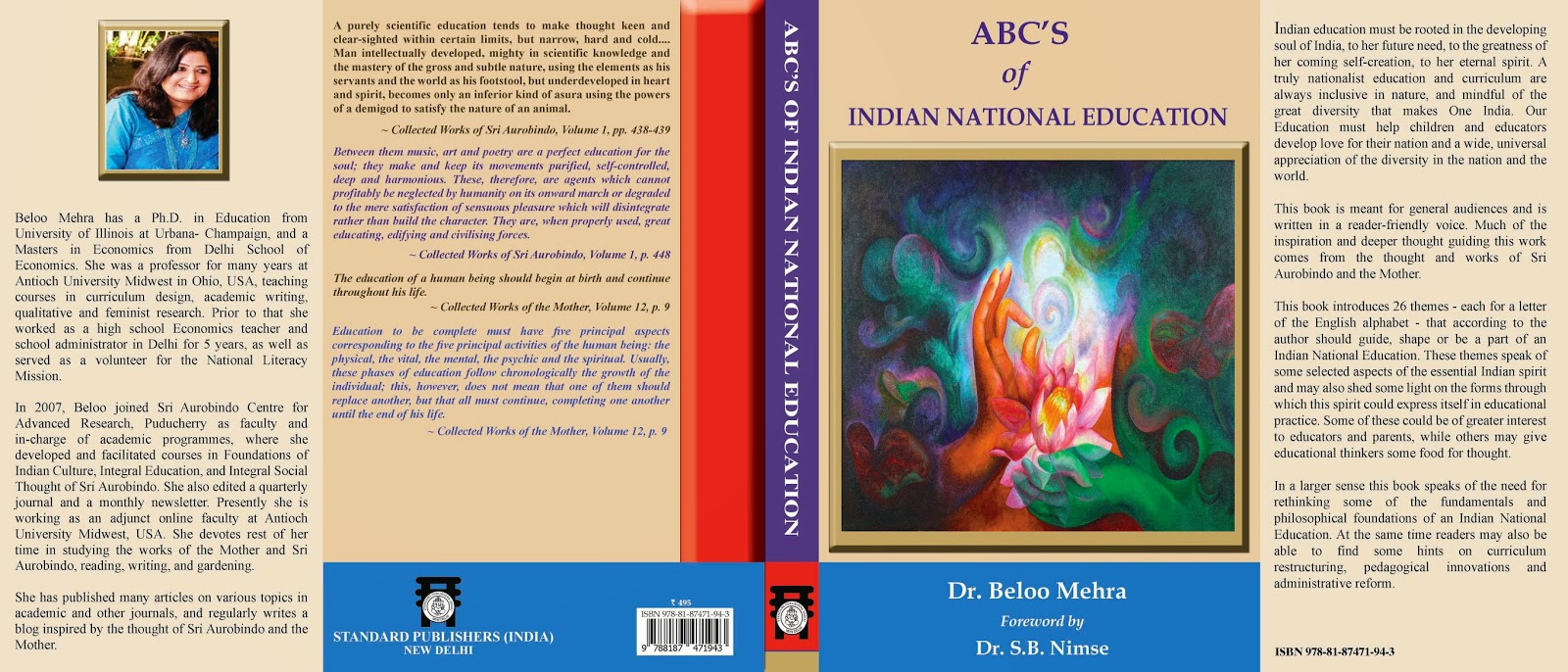
And then the time came to write another book. It gives me a very special joy when I open the first few pages of the advance copies of my newly released book, ABC's of Indian National Education and see this:


 To my Mother, my first teacher


Dear readers, I am happy to share that my book on Indian Education is now available for purchase at Amazon, where you can also read a brief overview of the book. And don't forget, you can always contact me, the author, for any thoughts you may have about the book.  

Regular readers of the blog may recall the A-Z series I did on Education in the month of April. This came together as a result of those blog posts, so my sincere thanks to all the readers of that series who encouraged me to think beyond the blog. 

I was fortunate enough to get some generous endorsements for the book from some esteemed teachers, colleagues and writers:
This book is a call for an educational approach that values the Spirit and builds upon India’s timeless wisdom of a life-affirming and living spirituality.  
Dr. Jane Brown
  Faculty Emerita, Antioch University Midwest, Yellow Springs, Ohio, USA 
                  
An educational policy bereft of the grand civilizational values of India reduces citizens to humdrum workers aspiring to nothing more than material security. This book provides the grounding essential to make Indians not just masters of the knowledge of the external but keen pursuers of knowledge eternal and internal.  Literally covering the issue, from A to Z, Dr. Mehra lays the groundwork for rethinking and re-framing India’s educational policy.                    
Dr. Ramesh Rao
Professor, Columbus State University, Columbus, Georgia, USA 
This book speaks of infusing Indian education with the Indian spirit. While it is inescapable that children have to pick up future careers, the author is opposed to making education strictly careerist, where childhood is suppressed and learning becomes mechanistic, soulless and joyless.    
N. V. Subramanian
Editor, www.newsinsight.net, Writer on politics and strategic affairs, Novelist, Delhi, India 

This book compels us to take a closer look at some of the fundamental issues regarding Indian education. Presenting the arguments with a modern approach, the book is deeply influenced by Sri Aurobindo's insights into the essential spirit of Indian culture and Education. All those interested in the future of Education in India and elsewhere will find it thought-provoking.
Kittu Reddy
Sri Aurobindo International Center of Education, Pondicherry 

http://www.amazon.in/Indian-National-Education-Beloo-Mehra/dp/8187471948

Click here to order


As I look at the book jacket and flip through the pages I see some errors, and after the first few minutes of self-criticism I remember what my mother always used to say -- 'now that you have finished your work, let it go, don't think too much about it, nobody can get it all right, learn from your mistakes and move on.' 

And so with this book done, I move on to other projects and other works, remembering her love and with full assurance that she is blessing me from wherever she is. My mother, my first teacher whose love for learning and teaching inspired me to do my best as a teacher, remains the reason for my passion for Education.

I wrote this book in gratitude and memory of all my teachers — past, present and future — who have shaped me into what I am today.

I offer this to That One Teacher who is Present in All.

*******
Linking this with ABC Wednesday, T: T is for Teacher


Friday, 31 October 2014

A Poet and A Painter: एक कवि और एक चित्रकार


"Poetry raises the emotions and gives each its separate delight. Art stills the emotions and teaches them the delight of a restrained and limited satisfaction..."
~ Sri Aurobindo


आज से ९ वर्ष पूर्व ३१ अक्टूबर २००५ को भारत की एक प्रसिद्ध कवियत्री और लेखिका इस दुनिया को छोड़ दूसरी दुनिया में जा बसी। अमृता प्रीतम की दर्द भरी कविताओं और संवेदनशील कहानिंयों एवं उपन्यासों ने भारतीय साहित्य के अनगिनत प्रेमियों के दिलो-दिमाग़ में अपना एक विशेष स्थान बनाया है। उनकी भाव-भरी रचनाएँ और उनके शब्द उनकी स्मृति को सदा ताज़ा ही रखेंगे, और साथ ही उनकी और इमरोज़ की अनूठी प्रेम-कथा साहित्य-प्रेमियों को एवं उनको भी जो प्रेम से प्रेम करते हैं आने वाले एक लम्बे समय तक अपने रंग में डुबोए रखेगी।

अमृता और इमरोज़ के एक दूसरे के प्रति प्रेम और समर्पण-भाव की कुछ झलक हमें उनके पत्रों द्वारा मिलती है, जिन पर आधारित एक पुस्तक भी अब पाठकों तक पहुँच चुकी है। अंग्रेजी भाषा में प्रकाशित पत्रों का यह संग्रह, जिसका शीर्षक है - "Amrita and Imroz: In the Times of Love & Longing"  दिल को छू लेता है। एक पत्र में इमरोज़ लिखते हैं - प्रेम ही दुनिया में एक मात्र स्वंत्रता है। तो दूसरे पत्र में हम अमृता को यह लिखते हुए पाते हैं - तुम ही तो हो मेरे १५ अगस्त।

उमा त्रिलोक की पुस्तक "अमृता-इमरोज़: एक प्रेम कथा" भी इस कवि और चित्रकार के अनोखे प्रेम एवं ४० वर्षों के संबंध की एक करीबी छवि प्रस्तुत करती है। इस पुस्तक की एक समीक्षा आप इस लिंक पर पढ़ सकते हैं।

लेकिन इन दोनों से परे है वह एक कविता जो अमृता ने लिखी थी, बीमारी के दिनों में अपने प्रेम के लिये।  मैं तैनू फेर मिलांगी (मैं तुझे फिर मिलूँगी) - पंजाबी भाषा में लिखी इस कविता का हिंदी अनुवाद भी उतना ही खूबसूरत है।


मैं तुझे फ़िर मिलूंगी
कहाँ किस तरह पता नही

शायद तेरी तख्यिल की चिंगारी बन
तेरे केनवस पर उतरुंगी
या तेरे केनवस पर
एक रहस्यमयी लकीर बन
खामोश तुझे देखती रहूंगी
या फ़िर सूरज की लौ बन कर
तेरे रंगो में घुलती रहूंगी
या रंगो कि बाहों में बैठ कर
तेरे केनवस से लिपट जाउंगी
पता नहीं कहाँ किस तरह
पर तुझे जरुर मिलूंगी

या फ़िर एक चश्मा बनी
जैसे झरने से पानी उड़ता है
मैं पानी की बूंदें
तेरे बदन पर मलूंगी
और एक ठंडक सी बन कर
तेरे सीने से लगूंगी

मैं और कुछ नही जानती
पर इतना जानती हूँ
कि वक्त जो भी करेगा
यह जन्म मेरे साथ चलेगा

यह जिस्म खतम होता है
तो सब कुछ खत्म हो जाता है
पर चेतना के धागे
कायनात के कण होते हैं

मैं उन कणों को चुनुंगी
धागों को बुनूँगी
मैं तुझे फ़िर मिलूंगी !

*******

Nine years ago from today, on 31st October 2005, an eminent Indian poet and author left this world to make her abode elsewhere. With her emotion-rich and heartfelt writing Amrita Pritam has made a special place for herself in the hearts of countless lovers of Indian literature. While her heart-touching poetry and sensitive portrayals will keep her memory alive, the one-of-a-kind love story of Amrita and Imroz will also keep enthralled, for a long time to come, the lovers of literature as well as all those who are in love with love.

The special bond of love and surrender to each other that Amrita and Imroz shared can be seen through the numerous letters they wrote to each other over the years. A book based on these letters is now also available for interested readers. Published in English, this collection of letters titled "Amrita and Imroz: In the Times of Love and Longing" is a delight. In one letter, Imroz writes to her - "Love is the only freedom in the world," and in another we find Amrita writing - "You are my 15th August".

Uma Trilok's book "Amrita-Imroz: A Love Story" presents a rare account of the unique love between a poet and a painter, and a special bond they shared for about 40 years. The book is available both in English and Hindi. A Hindi review of this book may be read here.

But beyond either of these books is that poem penned by Amrita herself, while she was very sick in later years of her life. The poem titled, Main Tenu Phair Milangi (I will meet you yet again) expresses so tenderly and beautifully what love meant to this poet-painter couple. Here it is in English translation, done by Nirupama Dutt.

I will meet you yet again
How and where
I know not
Perhaps I will become a
figment of your imagination
and maybe spreading myself
in a mysterious line
on your canvas
I will keep gazing at you.

Perhaps I will become a ray
of sunshine to be
embraced by your colours
I will paint myself on your canvas
I know not how and where —
but I will meet you for sure.

Maybe I will turn into a spring
and rub foaming
drops of water on your body
and rest my coolness on
your burning chest
I know nothing
but that this life
will walk along with me.

When the body perishes
all perishes
but the threads of memory
are woven of enduring atoms
I will pick these particles
weave the threads
and I will meet you yet again.


*******

You have now read the poem in Hindi and/or English. But nothing beats listening to the poem in its original language. And nobody recites Punjabi poetry better than Gulzar.

अब आप हिंदी अथवा अंग्रेजी में इस कविता को पढ़ चुके हैं। पर कविता का वास्तविक आनन्द तो उसकी मूल भाषा में ही मिल सकता है, और वो भी अगर गुलज़ार जैसी शख्सियत की आवाज़ में उसे सुना जाए। 


Image source: here
******
Linking this with ABC Wednesday, P: P is for Poet, Poetry, Painter